European paper wasps (Polistes dominula) are among the most commonly encountered stinging insects around homes in Los Angeles and Orange Counties. Originally from southern Europe, they were first reported in 1978 around Boston and have since spread west. They are now commonly found around Southern California homes and often show up closer to structures than many homeowners expect.
If you've noticed slender wasps with dangling legs hovering around your eaves, patio cover, or fence line, you're likely dealing with European paper wasps. Admiral Pest Control helps homeowners and property managers identify nesting activity and address paper wasp nests before stings become a concern.

European paper wasp activity usually starts low in winter while queens overwinter in protected cracks, crevices, and sheltered areas. Activity picks up in March and April as queens emerge and begin new nests.
From May through September, activity is high. Colonies grow quickly, workers forage throughout the day, and nests can reach full size by late summer. Activity begins to taper off in October and November as colonies decline and new queens look for overwintering sites. By December, activity is low again.
In coastal communities like Huntington Beach, Seal Beach, and Redondo Beach, mild winters can cause nest-building to begin a few weeks earlier than it does farther inland.
European paper wasps have a narrow, lightweight look compared with many other stinging insects. They are not as compact or thick-bodied as yellow jackets, and they often look more delicate when resting or flying.
Key identification features:
The easiest thing to notice from a safe distance is their shape in flight. European paper wasps often look narrow and leggy, with a slower, more deliberate flight than yellow jackets.
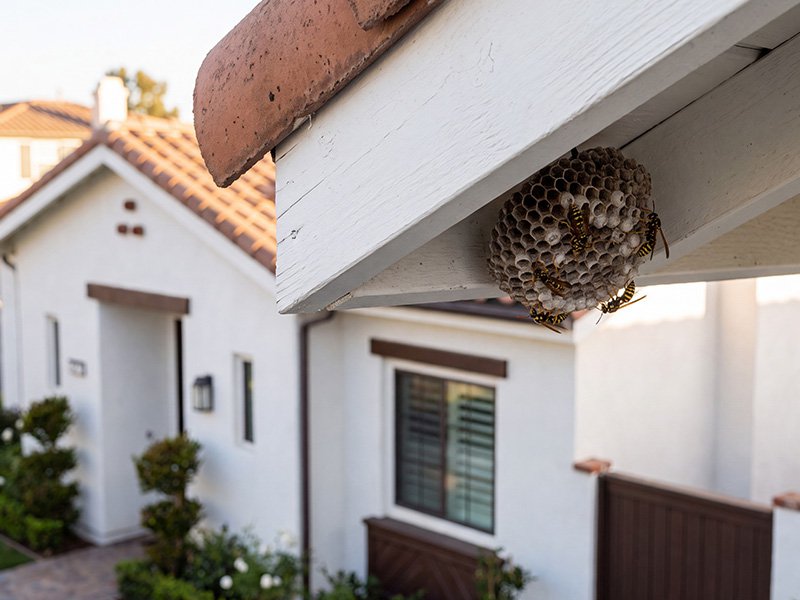
Paper wasps build open, umbrella-shaped nests from chewed wood fibers mixed with saliva. Unlike many yellow jacket nests, paper wasp nests do not have a papery outer shell, so you can usually see the individual cells where larvae develop.
Common nesting locations include:
Nests are often small enough to miss early in the season. In spring, a new nest may look like a small, flat cluster of exposed cells attached under an eave, patio cover, or other sheltered spot. By midsummer, the open comb can spread several inches across as the colony adds workers.
European paper wasps look for two things when choosing a nesting site: overhead shelter and a nearby food supply.
They feed their larvae protein — mostly caterpillars, beetle larvae, and other small insects they hunt from gardens and landscaping. Adults also drink nectar and are drawn to ripe fruit, sugary drink spills, and hummingbird feeders.
Across Orange and Los Angeles counties, mature landscaping and irrigated garden beds can also support the insects that paper wasps hunt, which is why activity may be seen in older neighborhoods like Bellflower, Downey, and Lakewood, as well as more landscaped communities like Irvine and Mission Viejo.
Not every wasp around your home is a paper wasp. Paper wasps usually build open nests where the cells are visible, while yellow jackets are more likely to use enclosed or hidden nest sites, including wall voids, attic gaps, and underground holes. Mud daubers are different again; they are solitary wasps that build small mud tubes instead of open paper nests.
If you are not sure whether you are seeing paper wasps, yellow jackets, mud daubers, or another stinging insect, Admiral Pest Control can identify the problem and recommend the right next step.
Paper wasps can sting multiple times and will defend their nest if threatened. Most stings happen when someone bumps into a nest they didn't see — reaching under a patio cover, opening a BBQ lid, or trimming shrubs.
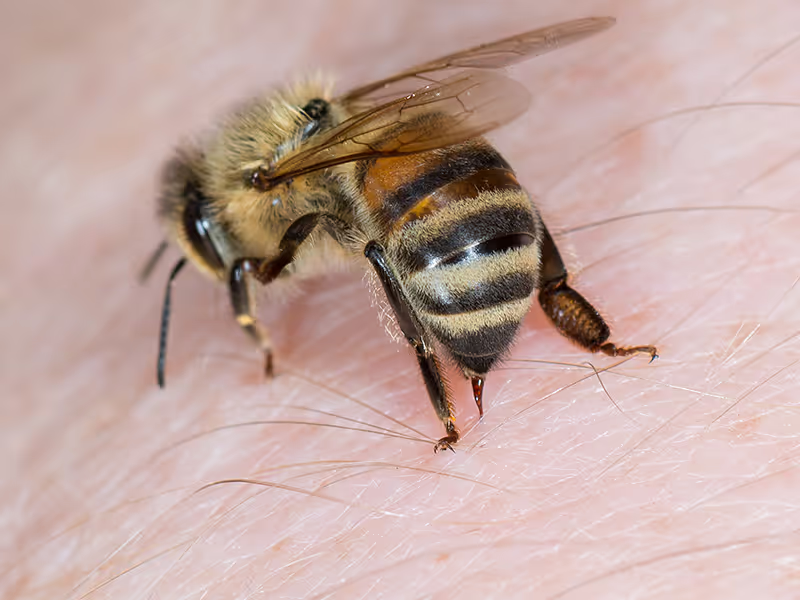
For most people, a paper wasp sting causes sharp pain, redness, and localized swelling that fades within a few hours. But for anyone with an allergy, a single sting can trigger a serious allergic reaction that needs immediate medical attention.
Because nests are often at head height or near walkways, patios, and play areas, the risk of an accidental sting increases as the colony grows throughout summer.
Common signs include:
Early-season nests in March and April may have only a single queen and a small cluster of exposed cells. By June, worker wasps are usually active, foraging for insects, and the nest may grow quickly.
Spraying a paper wasp nest with a store-bought aerosol can knock down the wasps you see, but it does not always solve the problem. It can also introduce real sting risk. Wasps away from the nest when you spray may return to find the colony disturbed, making them more defensive and more likely to sting.
Spraying from the wrong angle or distance can also agitate the colony before the product takes effect, increasing the chance of stings. If the nest is under a second-story eave, inside a soffit, or in another hard-to-reach spot, trying to treat it from a ladder can add a fall hazard on top of the sting risk.
For nests near doorways, patios, play areas, or pool decks, the biggest concern is what happens when the colony is disturbed. That risk is even more serious when kids, pets, or anyone with allergies may be nearby.
If you're finding paper wasp nests around your home in Bellflower, Irvine, Rancho Palos Verdes, or anywhere in our Los Angeles and Orange County service area, Admiral Pest Control can help.
All three of Admiral's residential pest control plans include exterior wasp nest removal (up to 12 feet) as part of our regular service. That means nests are addressed during your scheduled visits — and if new nests appear between appointments, you can request a service visit at no extra charge.
For commercial properties, Admiral provides tailored pest management for entryways, exterior gathering areas, storage areas, and other spots where wasp nests can create risk for employees, customers, or visitors.
Locally owned and family-operated since 1947, Admiral Pest Control knows where paper wasps nest around Southern California homes and businesses and how to treat them effectively.
In most cases, paper wasp colonies decline in late fall and winter. The workers and old queens die off, but newly mated queens survive in protected cracks, attic spaces, wall voids, and other sheltered spots. In mild coastal parts of Southern California, some activity may linger into December during warm stretches.
Usually not if you keep a few feet of distance and move calmly. Stings happen most often when someone accidentally bumps, vibrates, or blocks the nest entrance.
Occasionally. If there's a gap in siding, a broken vent screen, or an opening around a pipe, paper wasps may build inside a wall void or soffit. You'll usually notice wasps repeatedly entering and exiting the same small gap.
No. European paper wasps are an introduced species that can outcompete native paper wasps in some areas. They are brighter yellow than many native paper wasps, have orange-tipped antennae, and commonly nest around human-made structures.
It's common to find multiple nests on the same home, especially on properties with large eaves, covered patios, and detached garages. Each nest is a separate colony with its own queen.
Paper wasps are easier to deal with before the nest gets larger and more active. If you are seeing wasps around your eaves, patio cover, fence line, or another area frequently used by people, do not disturb the nest. Contact Admiral Pest Control for a free estimate.

I am completely satisfied with the services performed by Admiral Pest Control at my home for over 15 years. The inspection today was completed by Jeffrey; he completed a very thorough job of inspection and was super professional, very friendly and courteous. Highly recommended to anyone that wants termite and pest control services.
Donald T.
Irvine, CA

Aldo came by to service my property. He was polite, professional, and answered my questions regarding getting our property serviced. He was able to sweep potential areas that might have critters and the sprayed repellent for our quarterly treatment. Appreciate his professionalism and representation of this company.
Christian M.
Bellflower, CA

Jeffrey has been amazing!!! Very thorough and kind. We also caught a rat in less than 24 hours, which is a relief! Very grateful!
Hailey S.
Irvine, CA





Helpful Tips & Info