Spraying the Nest Mid-Day
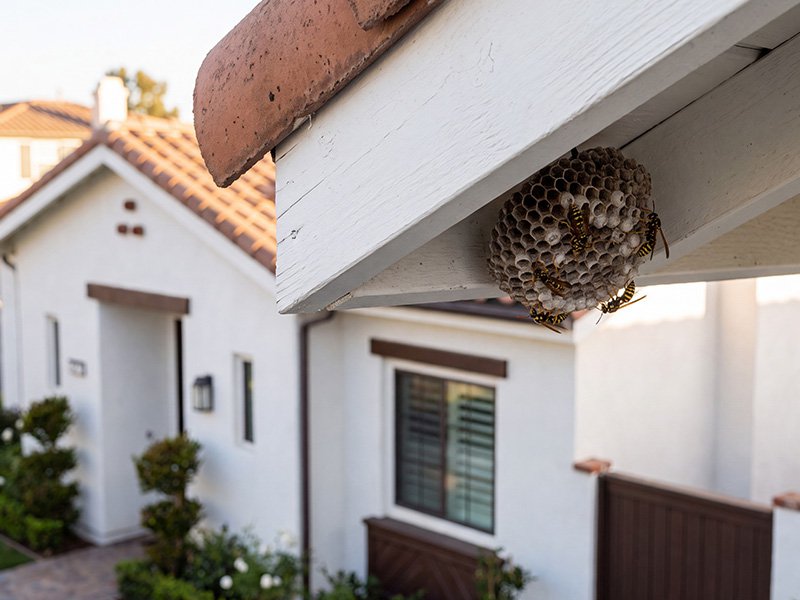
This is the big one. Most people grab a can of wasp freeze or wasp and hornet killer and go for it on a sunny afternoon, when the nest is busy and workers are constantly coming and going.
Even if you land a good shot, you're only hitting a fraction of the colony. The wasps you miss may swarm, and workers returning to the nest can add to the activity fast. Within seconds, you can have agitated wasps coming from more than one direction, which is how people end up with multiple stings before they make it back inside.
Worse, a partially treated nest may not die. The activity can shift deeper into a soffit, attic edge, or wall void, making the problem harder to reach. What started as a visible problem becomes a hidden one.
Knocking It Down With a Broom or Stick
A knocked-down nest is not a dead nest. The colony may still be alive, but now the wasps are agitated and harder to predict. Instead of one visible nest under the eave, you may have defensive wasps flying around the porch, entryway, or yard.
This is one of the DIY mistakes we hear about most often, and it is exactly the kind of situation that can send someone to urgent care.
Waiting to See If They Go Away on Their Own
We hear this a lot from homeowners across Orange County and Los Angeles County: "It was small when we first noticed it. We figured they'd move on."
They won't. A wasp colony that started in spring is still growing in July. What looked like a golf ball two months ago is now the size of a softball or larger, with hundreds of workers inside. By August, it may be even bigger. Waiting does not shrink the problem. It gives the colony more time to grow.
Sealing Up the Entry Point Before the Colony Is Dead
This feels logical. If you block the way in, they can't get out, right?
What actually happens is the colony chews through whatever material you used to seal it — or finds another exit point. In homes in Bellflower, Torrance, and other parts of LA County with older wood framing, that new exit point is sometimes directly into the interior wall. Now you have wasps inside your home, not outside.
The colony needs to be handled before the opening is sealed.
Using a Garden Hose to Blast It Off
A high-pressure stream of water will knock a nest loose, but again, the colony doesn't die. And unlike a can of spray, a garden hose keeps you standing in one spot for several seconds while a few hundred stinging insects decide what to do next. It also tends to scatter them at eye level. This is one of those ideas that sounds safer than it is.
Why July Is Especially Bad Timing for DIY
Here's something worth knowing: the nest you're looking at right now is significantly larger and more populated than it would have been two months ago.
Wasp and yellow jacket colonies build through spring and hit their peak in mid-to-late summer. By July, a colony that started with a single queen in April may have several hundred workers flying in and out all day and ready to defend the nest. That is a very different problem than the smaller nest you may have seen in May.
Southern California's mild winters also mean wasp activity ramps up earlier here than in most other parts of the country. Colonies in Orange County and LA County often get a head start — which is why July nests here tend to be larger than people expect.
If anyone in your household has a bee or wasp allergy, this isn't a risk worth taking at any point, but especially not now.
What You Can Actually Do Before Calling
There are a few things you can do while you wait for professional help, but none of them involve spraying, knocking down, sealing, or blasting the nest.
Stay away from the nest, especially when you see steady traffic in and out of the entry point. Keep kids and pets away from that part of the house until the nest is handled.
Keep windows and doors near the nest closed. Agitated wasps that can’t get back to the nest will sometimes fly toward light.
Don’t swat at them. Fast movement can trigger a defensive response. If one lands on you, stay still and wait for it to leave.
When to Call a Professional
The honest answer: almost always, for an active nest in July.
Call if the nest is near a door, window, play area, or anywhere your family regularly walks past. If it's larger than a baseball, if you can't clearly see the entry point, or if there's any chance it's inside a wall void or the attic, don't attempt it yourself.
Admiral's residential pest control plan includes exterior wasp nest removal up to 12 feet — which covers the eaves, soffits, and entry points where nests show up most often.
But that's just one piece of it. The plan covers year-round protection from the pests Southern California homeowners deal with most: ants, cockroaches, spiders, and more. You get quarterly treatments, interior service as needed, and if something shows up between visits — a wasp nest in July, for example — there's no extra charge for us to come back out.
So if you're already a customer, this is covered. And if you're not, a wasp nest by your front door in the middle of summer is a pretty good reason to change that.
Need Help With a Wasp Nest? Contact Admiral Pest Control
Local, family-owned Admiral Pest Control has served Orange County and Los Angeles County since 1947, including Bellflower, Irvine, Torrance, Long Beach, Rancho Palos Verdes, and surrounding communities.
Finding a wasp nest is stressful, especially when it is right by your front door, patio, garage, or another area your family uses every day. Leave it alone, keep kids and pets away from it, and let our experienced pest control team take care of it safely.
Contact Admiral Pest Control for a free estimate. Same-day service is often available.