Mice are small rodents that can live surprisingly close to people without being seen very often. In Southern California homes, the house mouse is the species most closely associated with indoor infestations.
Because mice are mostly active at night and tend to stay close to protected nesting areas, homeowners often notice droppings, gnaw marks, or noises before they actually see a mouse.

Mice are active year-round in Southern California, especially when they have dependable access to food and shelter. Activity around homes can become more noticeable in the fall as cooler nighttime temperatures encourage outdoor mice to move into structures.
Once mice are established indoors, they can remain active and reproduce year-round.
House mice are small, lightly built rodents with relatively large ears and a pointed nose.
Common features include:
Their small size is one of the easiest ways to distinguish adult mice from rats.
Young rats are sometimes mistaken for adult mice. A juvenile rat typically has a heavier body, a thicker tail, and noticeably larger feet and head in proportion to its body.
Mice tend to have a more delicate appearance, with a thinner tail and smaller feet.
If you only find droppings or hear movement inside a wall or attic, however, it may be difficult to tell which rodent is responsible without an inspection.
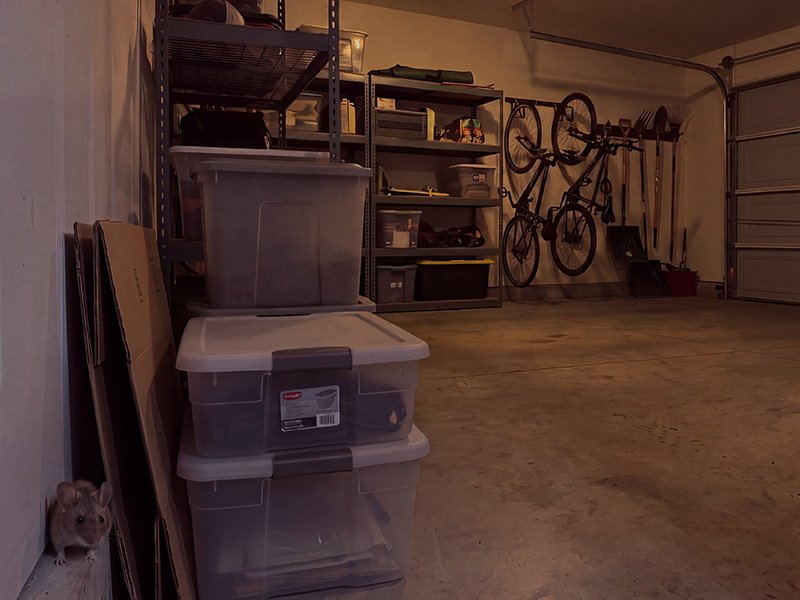
Mice prefer quiet, protected spaces close to food and nesting material. Inside Southern California homes, they may be found in:
Mice are also capable climbers, so activity is not limited to the ground floor.
Outside, they may shelter among dense vegetation, stored materials, sheds, garages, woodpiles, and other protected areas before entering a structure.
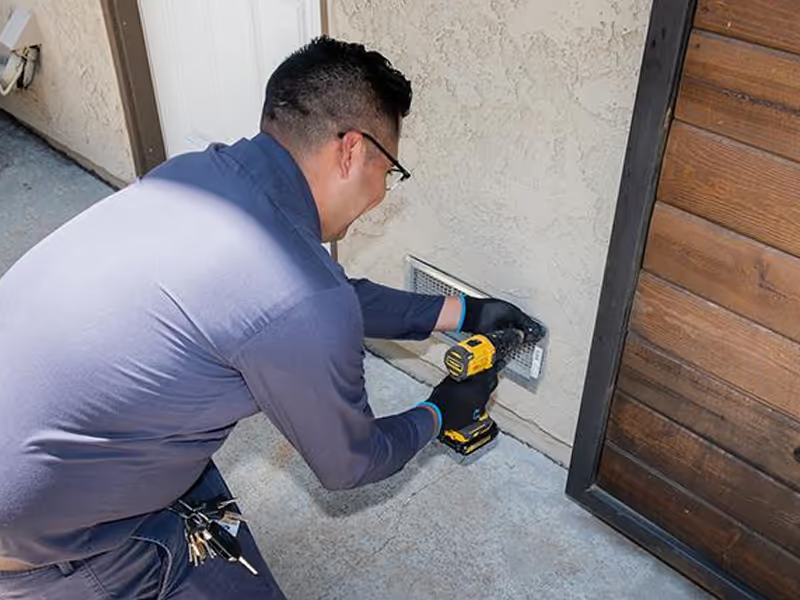
A mouse does not need a large opening to enter a home. Gaps around garage doors, utility penetrations, pipes, vents, exterior doors, siding, and other parts of the structure can provide access.
Mice can squeeze through openings only about 1/4 inch wide, which means an entry point can be easy to overlook during a quick walk around the house.
Our guide to how mice get into houses takes a closer look at common entry points and ways homeowners can make their homes less accessible to mice.
You may never see the mouse itself. More often than not, homeowners discover evidence of activity.
Common signs include:
Droppings may appear inside cabinets, along walls, beneath sinks, around stored belongings, or near food.
Avoid sweeping or vacuuming dry rodent droppings, since disturbing contaminated material can send particles into the air.
A home can provide nearly everything a mouse needs in a relatively small area.
Food can come from pantry goods, crumbs, pet food, birdseed, garbage, or food stored in a garage. Cardboard, paper, fabric, and insulation can serve as nesting material, while cabinets, wall voids, storage areas, and clutter provide places to hide.
Once mice find dependable food and shelter, they may remain close to that area rather than traveling far through the house.
Yes. Mice regularly gnaw because their front teeth continue to grow throughout their lives.
They may chew:
Mouse urine and droppings can also contaminate food, shelving, cabinets, insulation, and other surfaces.
Mice can contaminate food and surfaces with urine, droppings, and saliva. Rodents can also carry pathogens and may bring fleas or other parasites into the areas where they live.
The risk varies by situation, but evidence of mouse activity should be taken seriously, particularly when droppings or nesting material are found around food storage or living areas.
Their chewing can also damage electrical wiring and other materials inside a home.
Mouse prevention starts with reducing the things that make a property easy to enter or live in.
Helpful steps include:
Because mice can use extremely small openings, finding every potential access point can be difficult.
If you are seeing mice, finding droppings, or hearing activity inside your home, an inspection can help determine where rodents are active and how they are getting inside.
Admiral Pest Control’s rodent control services are tailored to the property and the extent of the problem. Depending on what the inspection finds, service may include interior trapping, exterior baiting, exclusion to close entry points, sanitation, and removal and replacement of contaminated insulation.
For homeowners looking beyond the immediate mouse problem, Admiral’s Home Protection Pest & Rodent Service provides continued rodent coverage along with year-round protection from common household pests. The plan includes exterior rodent control, helping prevent new mouse or rat activity rather than waiting for another indoor problem to develop. Interior trapping is included, as needed. A rodent inspection is required before the plan can be activated.
Not necessarily. However, mice spend much of their time hidden, so seeing one mouse or finding fresh droppings is worth investigating rather than assuming it was the only one.
Mice are primarily active at night, but daytime sightings can occur. A mouse may come out during the day when food is available or when its normal activity has been disturbed.
House mice can reproduce quickly when food and shelter are readily available. A female may produce 5 to 10 litters per year, with about 5 or 6 young per litter, and young mice can become sexually mature in as little as 5 to 6 weeks. That’s one reason it’s worth addressing mouse activity early rather than waiting to see if it goes away on its own.
If you have found mouse droppings, heard scratching in the walls, or spotted a mouse inside your home, Admiral Pest Control can help.
Admiral Pest Control has served Southern California since 1947, including communities throughout Orange County and southern Los Angeles County. Contact us today to request a free estimate for your mouse problem.

I am completely satisfied with the services performed by Admiral Pest Control at my home for over 15 years. The inspection today was completed by Jeffrey; he completed a very thorough job of inspection and was super professional, very friendly and courteous. Highly recommended to anyone that wants termite and pest control services.
Donald T.
Irvine, CA

Aldo came by to service my property. He was polite, professional, and answered my questions regarding getting our property serviced. He was able to sweep potential areas that might have critters and the sprayed repellent for our quarterly treatment. Appreciate his professionalism and representation of this company.
Christian M.
Bellflower, CA

Jeffrey has been amazing!!! Very thorough and kind. We also caught a rat in less than 24 hours, which is a relief! Very grateful!
Hailey S.
Irvine, CA






Helpful Tips & Info