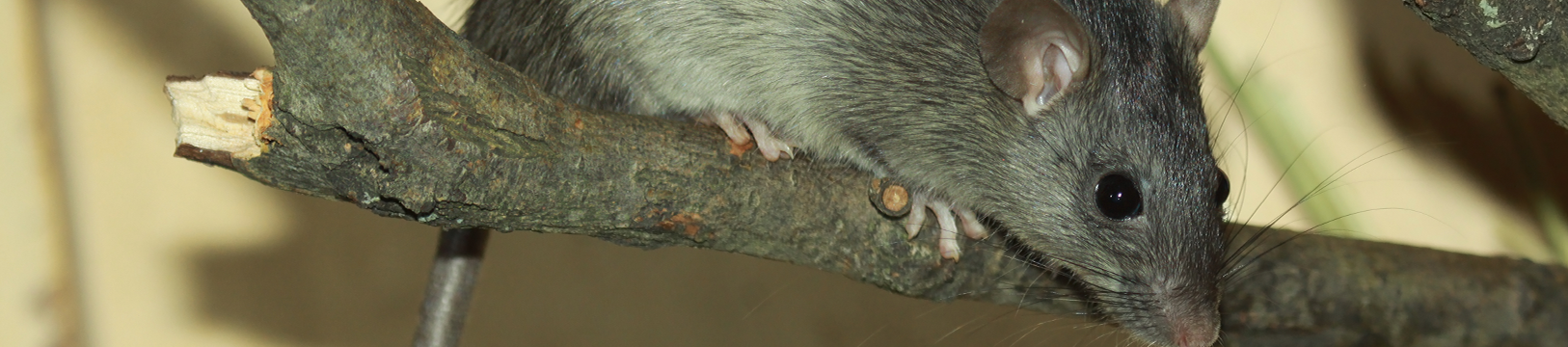
Roof rats are among the most common rats found around homes in Los Angeles and Orange counties. Also called black rats or ship rats, these rodents are excellent climbers and prefer to live above ground. They often move between fruit trees, fences, utility lines, roof edges, and attics.
Homeowners are more likely to hear roof rats or find evidence of their activity than see the rats themselves. Scratching overhead at night, droppings in the attic, and damaged fruit are all potential signs of a roof rat problem.

Roof rats are active year-round in Southern California, with activity generally highest during spring and fall.
Roof rats have slender bodies, pointed noses, large ears, and prominent eyes. Their fur can range from dark brown to black, often with gray mixed in.
Key identification features:
The long tail and slender body help distinguish a roof rat from a Norway rat. Norway rats are heavier and stockier, with blunt noses, smaller ears, and tails shorter than their head and body combined.
Young roof rats can also be mistaken for mice. Juvenile rats generally have larger heads and feet in proportion to their bodies.
Roof rats prefer elevated, protected areas. Around Southern California homes, they are commonly found in:
They can reach roofs by climbing trees, vines, fences, pipes, and utility lines. Once there, they may enter through damaged vents, gaps beneath roof tiles, openings along eaves, or spaces around pipes and utility lines.
The part of the home where you hear a roof rat may not be where it entered. Roof rats can travel through attics, ceilings, and wall voids after gaining access elsewhere along the roofline.
Because roof rats are nocturnal and often remain in concealed areas, infestations can go unnoticed at first.
Common signs include:
Roof rat droppings are generally about ½ inch long and spindle-shaped, with pointed ends. They may be found on attic beams, near insulation, along garage rafters, or close to stored food.
Avoid sweeping or vacuuming dry rodent droppings, as this can send contaminated particles into the air.
Roof rats eat many types of food but are especially attracted to fruit, nuts, seeds, and other plant material. Citrus, avocado, and other fruit or nut trees can provide dependable food around Southern California properties.
Fallen or unharvested fruit, birdseed, pet food left outdoors, open trash containers, compost, pantry food, and accessible water can also attract roof rats. Palms, dense ivy, shrubs, and tree canopies provide shelter and potential nesting areas.
Overhanging branches and heavy vegetation can also make it easier for roof rats to reach a home.
Roof rats can contaminate food, food-preparation areas, and stored belongings with urine, droppings, and saliva. They may also carry fleas and other parasites.
Their gnawing can damage electrical wiring, air ducts, PVC pipes, insulation, wood, and other building materials, as well as stored belongings.
Reducing food, shelter, and access around the property can make a home less attractive to roof rats.
Helpful prevention steps include:
Do not seal suspected entry points until you know whether rats are still inside. Closing an opening too soon can trap rodents in an attic, wall, or ceiling void.
If you’re hearing movement overhead or finding signs of roof rats at your home or business in Rancho Palos Verdes, Huntington Beach, or elsewhere in Los Angeles and Orange counties, Admiral Pest can help.
Our rodent control services address active infestations as well as the openings roof rats use to enter attics, garages, and other parts of a structure. Depending on the property and extent of the problem, service may include trapping, exclusion, sanitation, and insulation replacement.
Homeowners can also receive ongoing rat and mouse coverage through our Home Protection Pest & Rodent Service. For businesses and multi-family properties, our commercial rodent control services are tailored to the needs of the building and the areas where activity is occurring.
Admiral has served Southern California since 1947, and our technicians understand the elevated travel routes and entry points roof rats commonly use around local properties.
“Tree rat” is an informal name often used for roof rats because they climb and nest above ground. However, it is not a distinct scientific species name.
Yes. Roof rats can reach roofs by climbing fences, pipes, utility lines, vines, and some textured exterior surfaces. Trimming branches helps, but it does not eliminate every potential route.
Not necessarily, but one sighting should not be ignored. Roof rats usually remain concealed, so visible activity or fresh droppings can indicate that others are living or feeding nearby.
If you hear movement overhead, find droppings in the attic, or notice other signs of roof rats, Admiral Pest Control can help.
Request a free estimate from Admiral Pest Control today.

I am completely satisfied with the services performed by Admiral Pest Control at my home for over 15 years. The inspection today was completed by Jeffrey; he completed a very thorough job of inspection and was super professional, very friendly and courteous. Highly recommended to anyone that wants termite and pest control services.
Donald T.
Irvine, CA

Aldo came by to service my property. He was polite, professional, and answered my questions regarding getting our property serviced. He was able to sweep potential areas that might have critters and the sprayed repellent for our quarterly treatment. Appreciate his professionalism and representation of this company.
Christian M.
Bellflower, CA

Jeffrey has been amazing!!! Very thorough and kind. We also caught a rat in less than 24 hours, which is a relief! Very grateful!
Hailey S.
Irvine, CA






Helpful Tips & Info